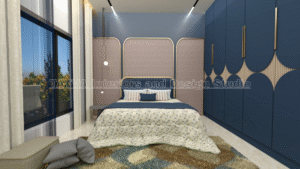
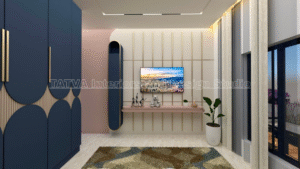
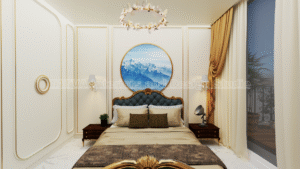
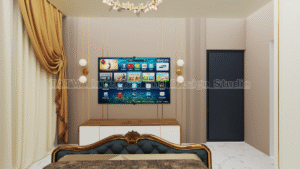
Sliding vs Hinged Wardrobes: Which Is Better for Indian Bedrooms?
Choosing the right wardrobe can make a significant difference to your bedroom. A well-designed wardrobe provides convenient storage, keeps everyday belongings organised and complements the overall interior design.
However, one important decision often confuses homeowners: should you choose a sliding wardrobe or a hinged wardrobe?
Both options offer practical benefits. Sliding wardrobes can help reduce the clearance needed in front of cabinet doors. Hinged wardrobes provide full access to individual cabinet sections when their doors are open.
The right choice depends on your bedroom dimensions, storage requirements, budget and personal preferences.
At Tatva Interiors & Design Studio, we believe that good furniture design should balance appearance and functionality. This guide compares sliding vs hinged wardrobes to help you choose a suitable option for your home.
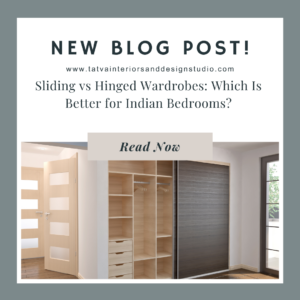
What Is a Sliding Wardrobe?
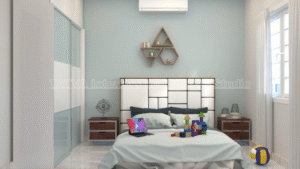
A sliding wardrobe uses doors that move horizontally along a track. Depending on the design, the doors may run on top-mounted, bottom-supported or other manufacturer-specific sliding systems.
Instead of swinging outward, the doors move across the wardrobe opening.
Sliding wardrobes are popular in contemporary bedrooms because they offer a clean appearance and can work well where floor space is limited.
Advantages of sliding wardrobes
1. Less door-swing clearance
Sliding doors do not need the same outward swing as hinged doors. This can be useful in bedrooms with narrow walking areas or furniture placed close to the wardrobe.
However, you still need sufficient space to stand comfortably and access the wardrobe.
2. Contemporary appearance
Large sliding panels can create a clean, uninterrupted look. You can select laminate, mirror, glass or other suitable finishes according to the design and hardware system.
3. Useful for selected compact bedrooms
Sliding wardrobes can help when a bed, side table or other furniture sits close to the wardrobe.
Before choosing this option, check the actual room dimensions and the clearance needed to open drawers or use other furniture.
4. Large decorative panels
Sliding shutters can accommodate coordinated colours, wood-look finishes and selected mirror panels. This makes it easier to create a unified bedroom design.
Disadvantages of sliding wardrobes
1. Only part of the wardrobe may be accessible at once
Most sliding systems allow one panel to move behind another. Consequently, you may not be able to open the entire wardrobe width simultaneously.
2. Track maintenance is important
Dust and debris can affect smooth operation. The track and rollers may require periodic cleaning and adjustment.
3. Hardware quality matters
The performance of a sliding wardrobe depends on the track, rollers, shutter weight, alignment and installation.
4. Drawers require careful planning
Internal drawers can become inconvenient if the sliding doors do not provide sufficient access. The designer must coordinate drawer positions with the door overlap.
What Is a Hinged Wardrobe?
A hinged wardrobe uses doors attached to the cabinet with hinges. The doors swing outward to reveal the storage space behind them.
This is a familiar wardrobe design that suits many traditional and contemporary bedrooms.
Hinged wardrobes can be customised with different shutter widths, finishes, handles and internal storage arrangements.
Advantages of hinged wardrobes
1. Wider access to the wardrobe
When the doors are fully open, you can access a large portion of the cabinet interior.
This makes it convenient to organise clothes, inspect shelves and use internal drawers.
2. Convenient internal storage
Hinged doors can work well with shelves, drawers, pull-out accessories and other storage features, provided the layout is planned correctly.
3. Straightforward operation
Hinged doors use familiar hardware. Quality hinges with suitable adjustment features can help maintain alignment during normal use.
4. Flexible design options
You can choose different shutter widths, handles, colours and decorative finishes to suit the bedroom.
5. Easier access to selected sections
Individual doors can open independently. This can be useful when you need to access a specific section without moving a large panel across the wardrobe.
Disadvantages of hinged wardrobes
1. They need outward clearance
The doors swing into the room. Therefore, the available space in front of the wardrobe must accommodate the door movement and the person using it.
2. Furniture placement requires attention
A bed, side table or chair may interfere with the doors if the wardrobe is too close.
3. Wide doors can become heavy
Large shutters need suitable hinges and correct installation. Excessive door width or weight can affect operation if the hardware is not properly specified.
4. Handles may project outward
Some handles occupy additional space. Handleless designs can reduce this issue, although the opening mechanism still needs to be practical.
Sliding vs Hinged Wardrobes: Key Differences
Use this comparison to understand the main differences before finalising your bedroom design.
| Feature | Sliding wardrobe | Hinged wardrobe |
|---|---|---|
| Door movement | Slides horizontally | Swings outward |
| Front clearance | Requires less door-swing space | Requires space for door opening |
| Access to the interior | Usually one section at a time | Wider access when doors are fully open |
| Hardware | Tracks and rollers or a specified sliding system | Hinges and associated fittings |
| Maintenance | Tracks and rollers need suitable care | Hinges may need adjustment |
| Internal drawers | Need careful alignment with door openings | Often easier to access when doors are fully open |
| Design appearance | Often suits a continuous modern look | Works with modern and traditional designs |
| Mirror integration | Large mirror panels are possible with suitable systems | Mirror panels can be fitted to suitable shutters |
| Cost | Depends on the track, shutters and finishes | Depends on hinges, shutters and finishes |
| Best planning consideration | Door overlap and access | Door-swing clearance |
Neither wardrobe type is automatically better for every bedroom. The right choice depends on the available space and how you intend to use the storage.
Which Wardrobe Is Better for a Small Bedroom?
Small bedrooms need careful planning because the bed, wardrobe, side tables and walking area compete for space.
A sliding wardrobe may be suitable when there is limited clearance between the wardrobe and nearby furniture. Since the doors move horizontally, they do not swing into the walking area.
However, the room still needs sufficient space for you to stand in front of the wardrobe and use its contents.
A hinged wardrobe can also work in a small bedroom if the doors have adequate opening clearance. The designer may adjust the door widths or furniture placement to improve access.
Before deciding, measure the following:
- Distance between the wardrobe and the bed.
- Available walking space.
- Wardrobe depth and overall width.
- Door opening requirements.
- Position of side tables and dressing units.
- Space needed for internal drawers.
Do not select a sliding wardrobe only because the bedroom is small. Compare both options using the actual floor plan.
Which Wardrobe Provides Better Storage?
The amount of storage depends primarily on the wardrobe dimensions and internal layout, rather than the door type alone.
Both sliding and hinged wardrobes can include shelves, hanging sections, drawers and selected accessories.
However, their door mechanisms affect how easily you can access that storage.
Storage in sliding wardrobes
Sliding wardrobes may work well with:
- Full-height hanging sections.
- Adjustable shelves.
- Dedicated luggage storage.
- Organised accessory compartments.
- Selected pull-out accessories.
However, internal drawers and pull-out units must align with the available opening. A drawer placed behind an overlapping panel may be difficult to use.
Storage in hinged wardrobes
Hinged wardrobes can provide convenient access to:
- Folded clothing shelves.
- Hanging sections.
- Internal drawers.
- Accessory organisers.
- Frequently used everyday items.
The doors can open wide enough to reveal a larger cabinet section, subject to the room’s clearance.
For either design, plan the storage around the clothes, accessories and household items you actually own.
Sliding vs Hinged Wardrobe Cost in India
There is no single price that applies to every wardrobe. The total cost depends on the dimensions, materials, hardware and installation requirements.
A sliding wardrobe may require a more specialised track and roller system. A hinged wardrobe requires suitable hinges and mounting hardware.
However, the price difference depends on the selected products and overall design.
Factors that influence the cost
Wardrobe dimensions: Larger wardrobes require more boards, shutters and finishing materials.
Shutter finish: Laminate, acrylic, glass, mirror and other finishes have different costs.
Hardware quality: Tracks, rollers, hinges, handles and soft-close mechanisms affect the budget.
Internal storage: Drawers, hanging rods, pull-out baskets and organisers add to the cost.
Cabinet construction: Board grade, thickness, edge finishing and manufacturing quality influence the quotation.
Installation: Site conditions, transportation, alignment and finishing can affect labour costs.
Special features: Integrated lighting, decorative profiles and customised designs may increase the project cost.
When comparing quotations, request a breakdown of the cabinet construction, shutter finish, hardware, internal accessories and installation.
This helps you understand whether the price difference reflects the door mechanism or other design choices.
Best Wardrobe Materials and Finishes
Once you decide on the door type, choose a suitable material and finish.
1. Matte laminate
Matte laminate offers a subtle appearance and suits many contemporary bedrooms. It is available in solid colours, wood-look designs and textures.
2. Glossy finishes
Glossy shutters can create a reflective appearance. However, fingerprints and smudges may be more noticeable on some colours.
3. Wood-look finishes
Wood-look finishes can introduce warmth into the bedroom. Pair them with neutral walls and coordinated furniture for a balanced design.
4. Mirror panels
Mirror panels can serve a practical purpose while creating a more open visual effect. However, consider privacy, cleaning and safe installation.
5. Two-tone wardrobes
Combining two finishes can create visual contrast without making the bedroom feel overly busy.
For example, warm wood tones with beige shutters can complement a neutral bedroom palette.
Always review physical samples under the room’s lighting before finalising the material.
How to Plan Wardrobe Interiors Properly
A wardrobe should be designed around your daily routine.
Hanging space
Consider the types of clothing you own and the amount of hanging space you require.
Long garments need different arrangements from shirts, trousers and folded clothing.
Drawers
Plan drawers for smaller garments, accessories and everyday essentials. Ensure that the drawer opening is not obstructed by the wardrobe door system.
Adjustable shelves
Adjustable shelves allow you to modify the arrangement as your storage needs change.
Loft storage
Loft cabinets can accommodate suitcases, seasonal clothing and other items used less frequently.
However, plan the height and access requirements carefully.
Access to frequently used items
Place everyday items where you can reach them comfortably. Keep less frequently used belongings in higher or less accessible sections.
A thoughtful internal layout can make a bigger difference to daily convenience than choosing a particular door mechanism.
Common Wardrobe Design Mistakes to Avoid
Mistake 1: Ignoring bedroom measurements
Measure the room before selecting wardrobe dimensions. Check the bed position, doorways, windows and circulation space.
Mistake 2: Choosing doors before planning storage
Decide how you want to organise your belongings before finalising the door system.
Mistake 3: Overlooking hardware quality
Tracks, rollers and hinges affect how the wardrobe operates. Select hardware appropriate for the shutter dimensions and weight.
Mistake 4: Placing drawers where access is restricted
This is especially important in sliding wardrobes. Coordinate drawer positions with the door overlap and available opening.
Mistake 5: Selecting finishes without considering maintenance
Choose a finish that suits your cleaning preferences and everyday use.
Mistake 6: Forgetting ventilation and wall conditions
Investigate dampness before installing a wardrobe against a wall. Address the source of moisture rather than relying on the wardrobe material alone.
Mistake 7: Comparing only the total quotation
Check the board specification, finish, hardware, accessories and installation scope before choosing a contractor.
How Tatva Interiors & Design Studio Can Help
A well-designed wardrobe requires coordinated planning of dimensions, storage, materials, hardware and bedroom circulation.
At Tatva Interiors & Design Studio, we provide interior design and execution services for residential and commercial spaces.
Our services can include:
- Bedroom furniture and wardrobe design.
- Space planning and layout development.
- Material and finish selection.
- Custom storage solutions.
- 2D drawings and 3D visualisation.
- Execution coordination according to the agreed project scope.
Our aim is to create interiors that combine practical storage with a coordinated design.
Explore our interior design services to learn more about our offerings.
You can also browse our project portfolio for examples of our design work.
Frequently Asked Questions
1. Which is better: sliding or hinged wardrobes?
Sliding wardrobes require less door-swing clearance, while hinged wardrobes provide wider access when fully open. Choose according to your room dimensions, storage layout and preferences.
2. Are sliding wardrobes suitable for small bedrooms?
They can be useful when the available space in front of the wardrobe is limited. However, you must still allow enough room to stand comfortably and access the wardrobe.
3. Are hinged wardrobes more affordable?
They can be more economical in some configurations, but the actual price depends on the shutters, hinges, finishes, dimensions and internal accessories.
4. Do sliding wardrobes require more maintenance?
Sliding systems require suitable track and roller maintenance. Hinged wardrobes may need hinge adjustments over time. Both benefit from proper installation and routine care.
5. Can I add mirrors to a sliding wardrobe?
Yes, suitable mirror panels can be incorporated into a sliding wardrobe system. The panel weight, safety requirements and hardware capacity must be checked.
6. Which wardrobe is better for accessing drawers?
Hinged wardrobes often provide wider access when the doors are fully open. Sliding wardrobes can also accommodate drawers, but their positions must align with the available opening.
7. Which wardrobe finish is best for Indian homes?
There is no single best finish. Matte laminate, glossy finishes and wood-look materials can all work well when selected according to the design, budget and maintenance preferences.
8. Can sliding and hinged wardrobes be combined?
Yes. A bedroom may use different door systems for separate storage units, provided the design remains practical and visually coordinated.
Conclusion
When comparing sliding vs hinged wardrobes, focus on the bedroom dimensions, available clearance, internal storage and everyday use.
Sliding wardrobes can be useful where door-swing space is limited. Hinged wardrobes can provide convenient access to the cabinet interior and may suit a wider range of storage arrangements.
Neither option is automatically better for every home. The best wardrobe is one that fits the room and makes your daily routine easier.
Planning a bedroom interior in Bengaluru, Kolar or Bangarpet?
Contact Tatva Interiors & Design Studio to discuss your wardrobe design and complete home interior requirements.
Visit our contact page to get started.